




Dragon Blood Stone
- Resilience
- Inner strength
- Courage
The energy you align with is the reality you create.
Where should we send your code?
Your code is on its way to you.
Not there in a few minutes? Look in your spam or promotions folder.
Crystal, Protection
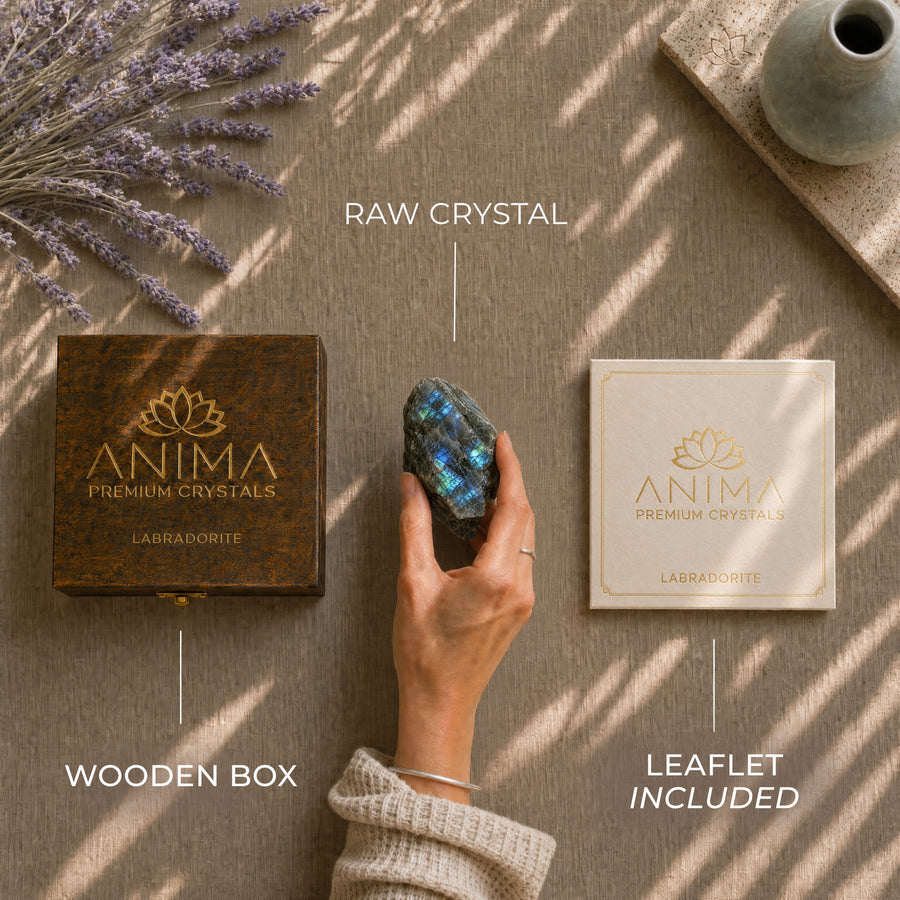
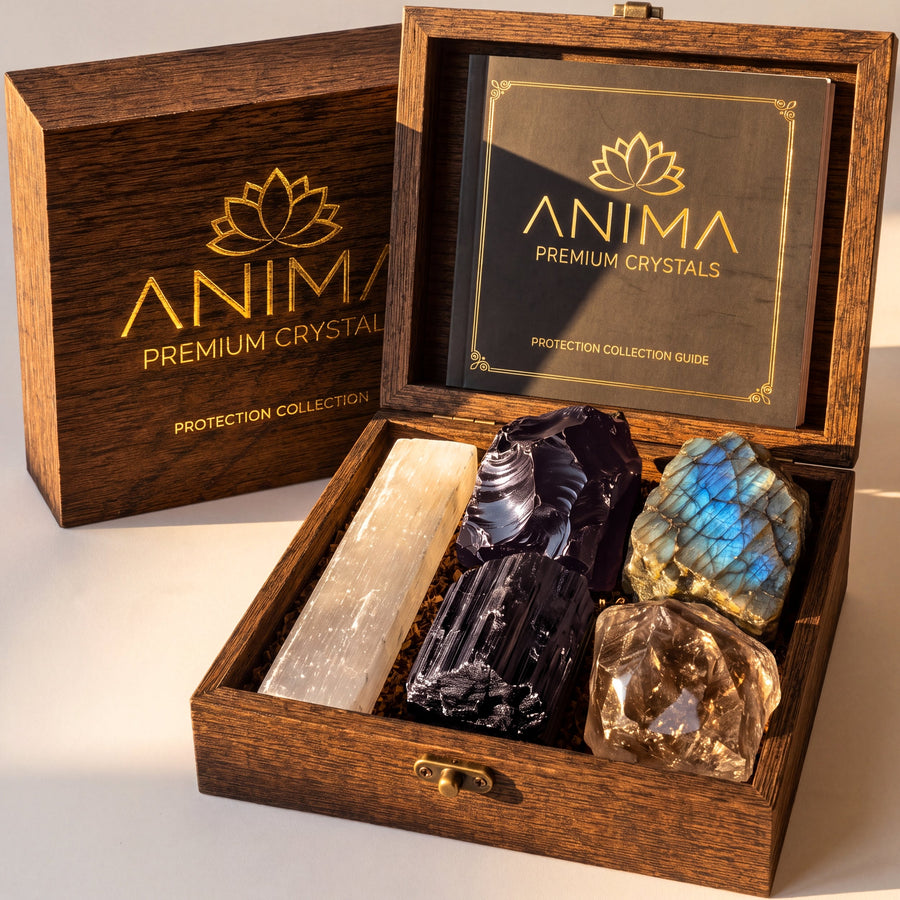
Inner strength through change, in a dark crystal that flashes blue, green and gold as you turn it.

Labradorite carries the shifting light of transformation. Hold it as you step into change and meet it with strength.
Everything is energy, always in motion, and labradorite makes that motion visible. Dark at first glance, it flashes into color the moment the light and your angle meet. Its frequency is the state of change embraced: the willingness to turn, look again and find what was there all along. Hold it as the colors move and you will feel steady inside the shift. The turn is yours.
Tune into
ANIMA energy
ProtectionAn energy that welcomes change.
What it brings youYou meet change with curiosity instead of fear.
Labradorite looks gray until the light hits it just right, then flashes blue, green and gold.
A heightened, clear inner sight.
What it brings youYou trust your first sense of things.
It is the crystal of the third eye, the center of inner sight.
A strong, luminous field around you.
What it brings youYou stay yourself through times of change.
Its flash of color comes from light bouncing between thin layers inside the crystal.
A quiet, steady courage.
What it brings youYou keep going when the path is new.
It was found on the coast of Labrador, Canada, in the 1770s.
A sense of wonder in everyday life.
What it brings youYou notice the small moments that feel like signs.
A legend says it holds the northern lights.
Light is energy in motion, and every color vibrates at its own frequency. Labradorite holds a whole spectrum in one gray crystal: turn it, and blue, green and gold appear. Its colors live in the light, not the crystal, the color of the third eye and of change.
Its flash, called labradorescence, comes from light reflecting between microscopic layers of feldspar inside the crystal. The thickness of the layers sets the color.
Its shades
The classic labradorite flash. Intuition and protection.
A cooler flash of sea green. Change with calm.
A rarer golden fire. Strength in transformation.
Labradorite works with your third eye and throat, where inner sight and expression meet.
Between the brows. Intuition, imagination and the quiet knowing behind a choice.
At the throat. Truth, voice and the courage to say what you mean.
Breathe in, 4 · Breathe out, 6
Hold your labradorite and tilt it slowly until it flashes, then follow the orb: in for four, out for six. Five slow breaths are enough to feel ready for change.
What you notice
“I welcome change. I meet it with strength.”
Leave it where daylight reaches it. Now and then it flashes as you move, and you remember the intention you set for this change.
Hold it, ask your question aloud, and write your first, unedited answer.
Carry it through a move, a new job or any season of change.
When you feel stuck, turn it slowly and look at your question again.
Before a decision. Hold it, ask your question out loud, and write down your first, unedited answer, before your thinking mind steps in.
Through a transition. Carry it through a move, a new job or any season of change, as a touchstone for the strength you already have.
A new angle. When you feel stuck, turn the crystal slowly until the color appears, and let it remind you that clarity comes when you change your angle.
A dream journal. Keep it on your nightstand beside a notebook, and write down what you remember when you wake.
Labradorite is a plagioclase feldspar famous for labradorescence, a flash of color that sweeps across the dark gray crystal as you turn it. It comes from light between thin inner layers, not from pigment.
As labradorite cooled deep underground, it separated into extremely thin, alternating layers of two slightly different feldspars. Light bouncing between those layers interferes with itself, as it does on a soap bubble, so only certain colors reach your eye, and only from certain angles. Blue and green are the most common, then gold and orange, with rare purple and pink.
It is a calcium and sodium aluminum silicate from the feldspar group, the most abundant minerals in Earth's crust. It rates 6 to 6.5 on the Mohs scale and has cleavage, so it can split along flat planes if knocked hard, which is why raw pieces often show flat, flaky surfaces. The best iridescent labradorite comes from Canada, Finland and Madagascar.
Labradorite is first recognized in Labrador, on Canada's Atlantic coast.
Moravian missionaries found their mission at Nain, and soon send specimens to London.
Labradorite with vivid, full-spectrum color is found near Ylämaa, in Finland.
Labradorite is named for Labrador, on Canada's Atlantic coast, where it was first recognized in 1770. Its type locality, the place it was first described from, is Paul's Island, near Nain. Moravian missionaries, who founded their mission at Nain in 1771, soon sent specimens to London, and the mineral took the name of the land where it was found.
A popular story, often told as an Inuit legend, says the northern lights were once trapped in the rocks of the Labrador coast until a warrior struck them with his spear and set most of them free, leaving a little light behind in the rock. We share it as legend.
In 1940, labradorite with vivid, full-spectrum color was found near Ylämaa, in Finland, during construction of the Salpa Line, a chain of wartime fortifications. The name spectrolite is credited to the geologist Aarne Laitakari, and it is still the trade name for this Finnish material.
 Labradorite and Moonstone
Two feldspars of light: intuition and new beginnings.
Explore Moonstone
 Labradorite and Lapis lazuli
Intuition meets truth, a pair for the third eye and the throat.
Explore Lapis lazuli
 Labradorite and Black tourmaline
A protective pair for times of change.
Explore Black tourmaline
Clean it with warm, soapy water and a soft cloth, never ultrasonic or steam cleaners.
Store it where it cannot be knocked, apart from harder crystals such as quartz.
Renew it with incense or herb smoke, the sound of a bell, or moonlight.
Clean labradorite with warm, soapy water and a soft cloth or brush, then rinse and dry it. Avoid ultrasonic and steam cleaners, high heat, sudden temperature changes and harsh chemicals. Because it can split along its cleavage, store it where it cannot be knocked, and keep it apart from harder crystals such as quartz, which can scratch it.
Renew it whenever it feels right: pass it through incense or herb smoke, ring a bell or singing bowl beside it, or leave it in moonlight overnight. A quick rinse is fine too, but skip long soaks and salt, which can work their way into cracks in raw pieces.
From the ANIMA collection
Mentioned in this guide
 3 pieces, chosen together
Centered before you meet the world.
In your bundle
The energy quiz
Which energy is seeking you?
A few quick questions reveal the energy calling you now.
Zodiac crystal sets
Find your zodiac crystals
Six crystals that carry the energy of your sign.
Good to know
Labradorite holds the energy of transformation: light that waits inside a dark crystal until you turn it. Reach for it whenever life is changing. With your intention set and the crystal in your hand, you will feel your inner strength rise. You are the creator.
Yes, briefly. Labradorite does not dissolve, so a quick wash in warm, soapy water is fine. Do not soak it or leave it in water, avoid salt water and hot water, and dry it right away, especially raw pieces with cracks.
Labradorescence only appears at certain angles. Turn the crystal slowly under a single light source, such as a window or a lamp, rather than soft overhead light. Raw pieces often flash on only one face, and some are naturally more subtle than others.
No, although both are feldspars. Moonstone shows a soft, floating glow from fine layers of orthoclase and albite, while labradorite shows bright flashes of color. The trade name rainbow moonstone actually refers to a pale, transparent labradorite.


