




Dragon Blood Stone
- Resilience
- Inner strength
- Courage

The energy you align with is the reality you create.
Where should we send your code?
Your code is on its way to you.
Not there in a few minutes? Look in your spam or promotions folder.
Crystal, Protection
A pale, moonlit glow that quiets a room: selenite, the gentle gypsum crystal that always stays dry.

Selenite holds a soft, luminous energy of light. Place it near you and feel the space around you grow clear and calm.
Named for the moon, selenite glows the way moonlight falls across a quiet room. Its frequency is light itself: soft, clear, unhurried. Its energy is the state of an uncluttered space, inside you and around you. When you tune into it, you will feel the air grow still and your thoughts settle into that glow. Selenite holds the light. The clarity you keep is yours to choose.
Tune into
ANIMA energy
ProtectionA pure, bright energy.
What it brings youYour space feels brighter and lighter.
Selenite takes its name from Selene, the Greek goddess of the moon.
A clear, open energy.
What it brings youYour thoughts settle and clear.
Its long, silky fibers carry light along their length.
A soft, gentle quiet.
What it brings youA calmer mind and a calmer room.
Its glow is pearly and soft, like moonlight.
An energy that keeps your space clear.
What it brings youYour home holds the calm you create.
It is the fourth step of the ANIMA ritual: selenite maintains.
A connection to light and stillness.
What it brings youMeditation that feels light and wide.
It is the crystal of the crown, the highest energy center.
Light is energy in motion, and every color vibrates at its own frequency. Selenite is white and pearly, letting light glow along its fibers. It carries the pure, open frequency of white light, the color of the crown.
It is pure gypsum, with nothing to tint it. Its silky glow comes from long fibers that guide light along their length.
Its shades
The silky, fibrous form most people call selenite. Pure light.
Water-clear gypsum crystals. Clarity.
Gypsum grown with sand into rose-like shapes. Calm, grounded light.
Selenite works with your crown, the center of awareness and light.
At the top of the head. Stillness, presence and a connection to something larger.
Breathe in, 4 · Breathe out, 6
Hold your selenite in both hands and follow the orb: in for four, out for six. Five slow breaths are enough to feel light and clear.
What you notice
“I maintain clarity within myself and within this space.”
In lamplight its silky lines shimmer, a small sign of the clarity you set for this room.
Its soft glow on the nightstand marks the quiet close of the day.
Hold it lengthwise and follow its fine lines as you breathe.
On a full moon evening, set it on an indoor windowsill, never outdoors.
By your bed. Place the bar on your nightstand. When you turn out the light, rest your eyes on its glow for a moment and let it mark the close of the day.
After you clear a space. Once a room feels clear, place selenite where you want it to stay that way: a doorway, a windowsill, a desk or a bedside table. Each time you see it, let it remind you of the clarity you have chosen.
In meditation. Hold the bar lengthwise in your palms and follow its fine lines with your eyes as you breathe. When your mind wanders, come back to its light, and say: "I maintain clarity within myself and within this space."
Under the moon. Selenite is named for the moon, so we love to make a small ritual of a full moon evening. Set it on an indoor windowsill in the moonlight, never outdoors, where dew or rain can reach it.
Selenite is a crystalline form of gypsum, a soft mineral of calcium sulfate and water. It is so soft a fingernail can scratch it, and water slowly dissolves it.
Gypsum is one of the most common minerals on Earth. It forms where mineral-rich water slowly evaporates or cools, and it is the same mineral that is heated and ground to make plaster. Mineralogists keep the name selenite for clear, glassy crystals that split into thin sheets. Satin spar is gypsum made of fine parallel fibers, with a silky white glow, and alabaster is the fine-grained, solid form used for carving. Many of the wands, bars and towers sold as selenite are, strictly speaking, satin spar. Both are gypsum, so they share the same story and the same care.
Every form is soft. Gypsum marks 2 on the Mohs scale itself, so a fingernail can scratch it, and harder crystals such as quartz mark it easily. It is also slightly soluble: water dulls its surface, etches it and, over time, dissolves it. That is why selenite is never washed or soaked.
Pliny the Elder writes of selenitis, a white gem holding an image of the moon.
Panes of clear gypsum, lapis specularis, fill windows in some of Rome's early churches.
The Swedish mineralogist Wallerius names clear gypsum crystals selenites.
The name comes from the Greek selēnē, the moon. In Greek myth, Selene was the goddess of the moon, and she drove her chariot across the night sky. The crystal's soft, moonlike glow earned it her name. Selenite has nothing to do with the element selenium, although both names come from the same Greek word.
In the first century, the Roman author Pliny the Elder wrote of a gem he called selenitis: white and see-through, with an image of the moon inside that, he wrote, grew and faded with its phases. No one knows which mineral he meant. In 1747 the Swedish mineralogist Johan Gottschalk Wallerius gave the name selenites to clear gypsum crystals, and it has stayed with them since.
The Romans split a transparent gypsum they called lapis specularis into thin, light-filled panes for their windows, and the mines around Segóbriga, in central Spain, gave the clearest sheets; the trade peaked in the first and second centuries. Panes of it still filled windows in some of Rome's early medieval churches.
In 2000, two brothers drilling about 300 meters (1,000 feet) down in the Naica mine, in northern Mexico, broke into a cave of giant selenite beams, the largest more than 11 meters (36 feet) long. They had grown slowly in hot, mineral-rich water over hundreds of thousands of years. The air inside was so hot and humid that visitors wore cooling suits to stay more than a few minutes. The Cave of the Crystals holds some of the largest natural crystals ever found.
 Selenite and Amethyst
Rest amethyst on selenite to renew it between rituals.
Explore Amethyst
 Selenite and Clear quartz
Two crystals of light: clarity for you, and for your space.
Explore Clear quartz
 Selenite and Black tourmaline
Shadow and light: selenite keeps the space clear, black tourmaline shields.
Explore Black tourmaline
Keep it dry, always: never wash or soak it, and skip steamy bathrooms and salt bowls.
Dust it with a soft, dry brush, and store it apart from harder crystals.
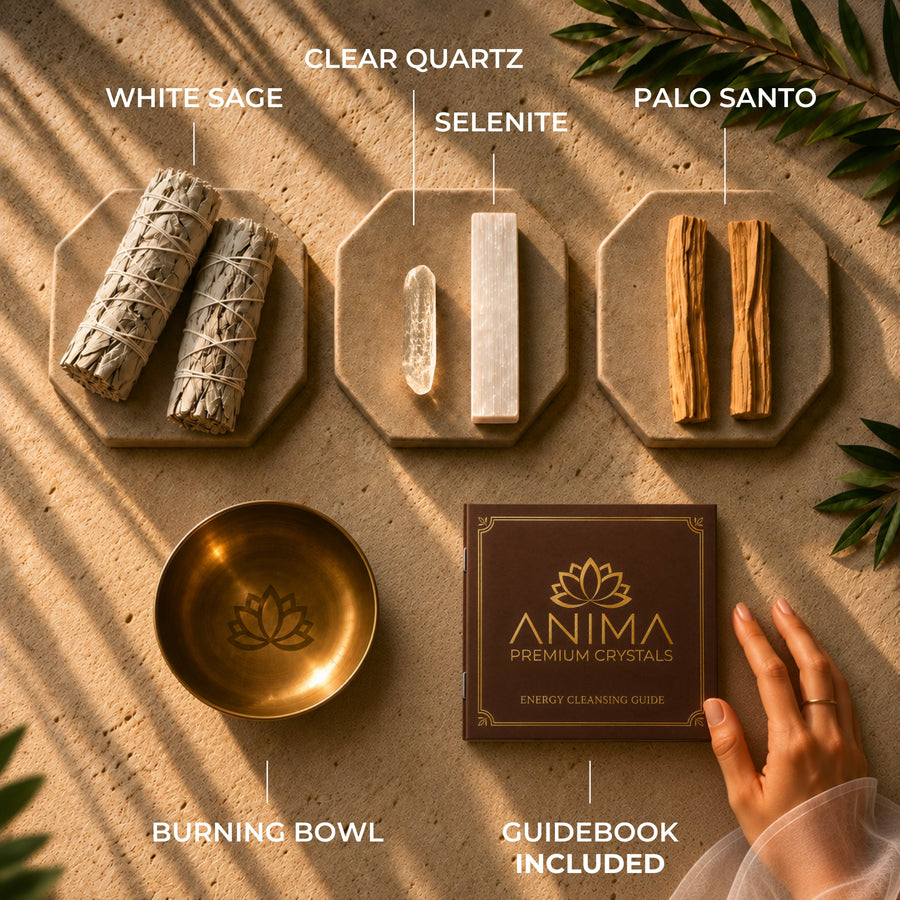
Renew it with sage or palo santo smoke, indoor moonlight or a restated intention.
Keep selenite dry, always. Never wash it, soak it or leave it in a steamy bathroom, and skip salt bowls, which hold moisture. To clean it, dust it with a soft, dry brush or wipe it with a dry cloth.
Selenite is soft, so give it its own place. Store it apart from harder crystals, which can scratch it, and set it down gently: bars can split along their length, and rough ends can flake.
Renewal is a small act of attention, and for selenite it is always dry. Pass it through the smoke of sage or palo santo, rest it in moonlight indoors, or simply hold it and restate your intention.
From the ANIMA collection
Mentioned in this guide
 3 pieces, chosen together
Centered before you meet the world.
In your bundle
The energy quiz
Which energy is seeking you?
A few quick questions reveal the energy calling you now.
Zodiac crystal sets
Find your zodiac crystals
Six crystals that carry the energy of your sign.
Good to know
Selenite's energy is the stillness of moonlight on fresh snow: hushed and bright. Set your intention beside it, and you will feel your mind grow spacious and open. Its light keeps the space. You are the creator.
No. Selenite is a soft form of gypsum that slowly dissolves in water, so even a short soak can dull or etch it. Dust it with a dry, soft brush or cloth, and keep it out of bathrooms and away from open windows on rainy days.
Possibly, and that is fine. Mineralogists keep the name selenite for clear, glassy gypsum and call the silky, fibrous kind satin spar, but most selenite wands, bars and towers in crystal shops are satin spar. Both are gypsum, with the same softness, the same care and the same moonlit glow.
Somewhere dry, where you will see it: a windowsill, a doorway, a desk or a bedside table. Keep it out of bathrooms and kitchens, away from steam, flames and radiators, and apart from harder crystals that can scratch it.
No. Selenite contains no selenium. The two names share a Greek root, selēnē, the moon.


