





Dragon Blood Stone
- Resilience
- Inner strength
- Courage
The energy you align with is the reality you create.
Where should we send your code?
Your code is on its way to you.
Not there in a few minutes? Look in your spam or promotions folder.
Crystal, Protection
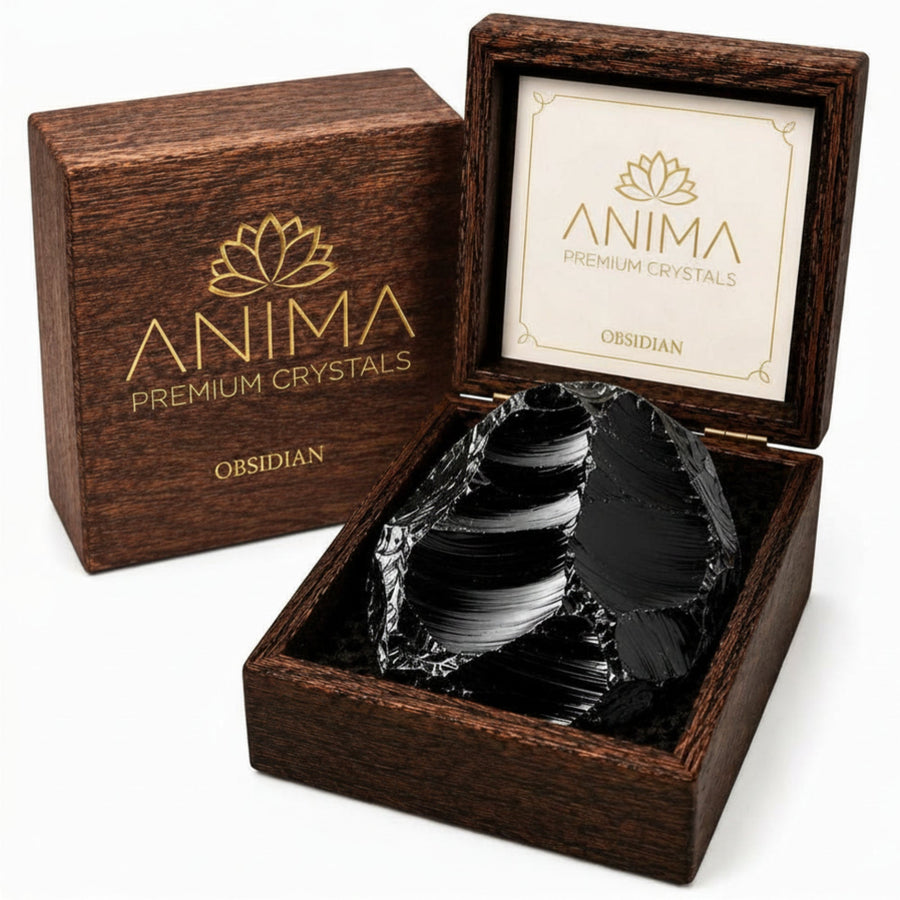
Release what no longer serves you: obsidian, the volcanic mirror, carries a deep energy of protection and inner strength.

Obsidian brings to the surface what no longer serves you, so you can release it and stand in your own strength.
Born of fire, obsidian holds a deep, reflective frequency. Its energy is the state of honest seeing: still, protected, unafraid of the dark. When you tune into it, you will feel what you have been carrying come into view, and with it the choice to set it down. Obsidian shows you. You decide what to release.
Tune into
ANIMA energy
ProtectionAn energy that lets go of what no longer serves you.
What it brings youYou stop carrying yesterday into today.
Obsidian is lava that cooled so fast it never had time to form crystals.
A strong, reflective energy around you.
What it brings youYou stay steady when others are not.
Its glassy black surface acts like a dark mirror.
An honest look within.
What it brings youYou see your own patterns clearly, and choose again.
People have polished obsidian into mirrors for thousands of years.
A deep, earthy energy from the heart of a volcano.
What it brings youSolid footing when life moves fast.
It is born of fire and rock, the root of the earth.
A focused, quiet power.
What it brings youYou hold your ground, kindly and clearly.
Its fresh edges are sharper than steel.
Light is energy in motion, and every color vibrates at its own frequency. Black absorbs them all and gives none back. Obsidian carries that deep, inward energy, the color of the root and of the volcano it came from.
Its black comes from tiny crystals of magnetite and other minerals suspended in the glass. Fine bubbles or mineral layers give some pieces a golden or rainbow sheen.
Its shades
The classic deep black. Strong, reflective protection.
White flower-like patterns of cristobalite in the black. Release with light.
Black swirled with red-brown iron. Warm, grounding strength.
Obsidian works with your root, the center of grounding and safety.
At the base of the spine. Safety, stability and the feeling of solid ground beneath you.
Breathe in, 4 · Breathe out, 6
Hold your obsidian in both hands and follow the orb: in for four, out for six. With each breath out, let go of one thing you no longer need.
What you notice
“I release what no longer serves me. I stand in my strength.”
Wherever you set it down, it sits black and quiet, a reminder to leave what you released behind you.
In the evening, look into it and ask: what am I ready to see clearly?
By your journal, write one thing you let go of and one you choose instead.
By the door or on your desk, a quiet sign of your boundaries.
A mirror moment. In the evening, hold a polished piece, look into it or simply at it, and ask yourself: what am I ready to see clearly?
Release and claim. With the piece beside your journal, write one thing you are letting go of and one thing you are choosing instead.
Mark your space. Keep it by the door or on your desk as a quiet sign of your boundaries.
Ground before you go. Stand with your feet flat on the floor, hold your obsidian and take a minute of slow breathing before you leave home.
Choose the right piece. Smooth, tumbled obsidian is best for carrying in a pocket. Keep sharp raw pieces for display or for holding with care.
Obsidian is natural volcanic glass, formed when silica-rich lava cools too fast for crystals to grow. It breaks with smooth, curved, shell-like surfaces, and its edges can be astonishingly sharp.
Because its atoms never line up into crystals, geologists call obsidian a mineraloid rather than a mineral. It rates about 5 to 5.5 on the Mohs scale, softer than quartz, and it chips and scratches easily.
Most obsidian is black, darkened by tiny particles of iron-rich minerals. Snowflake obsidian is dotted with white clusters of cristobalite, mahogany obsidian has red-brown, iron-rich streaks, and golden sheen and rainbow obsidian glow with tiny bubbles or mineral particles lined up as the lava flowed. Over millions of years it slowly turns crystalline, so most of it comes from geologically young volcanoes.
Its edges make it a prized material for blades.
Polished discs at Çatalhöyük, in Turkey, are often called some of the earliest mirrors.
A study traces John Dee's Aztec obsidian mirror to Pachuca, in central Mexico.
Its edges made obsidian one of the most valued materials for blades from the Stone Age onward, and because each volcano gives its obsidian a chemical fingerprint, archaeologists can trace pieces back to their source and map ancient trade. Nearly 2,000 years ago, people of the Hopewell culture in Ohio held obsidian from Obsidian Cliff, in what is now Yellowstone National Park, more than 1,400 miles away.
Polished obsidian was also among the first mirrors. In Mesoamerica, Aztec artists made obsidian mirrors, the emblem of the god Tezcatlipoca, whose name means "Smoking Mirror." One of those mirrors reached Elizabethan England and belonged to the scholar John Dee. It is now in the British Museum, and in 2021 its obsidian was traced to Pachuca, in central Mexico. The name obsidian goes back to the Roman writer Pliny the Elder, who described a dark volcanic glass named after Obsius, a man who found a similar glass in Ethiopia.
Wipe it with a soft cloth, or rinse it briefly in lukewarm water and dry it at once.
Store it in a cloth pouch or its own box, apart from harder crystals such as quartz.
Renew it with smoke, sound or a night of moonlight, and name what you release.
Obsidian is glass, so care for it the way you would care for fine glassware. Avoid harsh cleaners and sudden temperature changes, which can crack it, and do not store it loose with harder crystals such as quartz, which will scratch it. A cloth pouch or its own box keeps it bright.
Renewal suits obsidian's energy of release. Pass it through incense or herb smoke, let a bell or singing bowl ring beside it, or leave it in moonlight overnight, and say aloud what you are letting go. All three are gentle on the glass. If you prefer water, keep it brief and lukewarm.
From the ANIMA collection
Mentioned in this guide
 3 pieces, chosen together
Centered before you meet the world.
In your bundle
The energy quiz
Which energy is seeking you?
A few quick questions reveal the energy calling you now.
Zodiac crystal sets
Find your zodiac crystals
Six crystals that carry the energy of your sign.
Good to know
Obsidian carries a deep, reflective energy of release, protection and inner strength. It brings to the surface what no longer serves you, so you can see it clearly and let it go. Name what you are ready to release as you hold it, and you will feel yourself stand stronger in who you are. You are the creator.
Shadow work is the practice of looking, with kindness, at the parts of yourself you usually keep hidden. Obsidian's reflective energy makes it a natural companion for it. In a quiet moment, hold the piece, ask what you are ready to see, and write down whatever comes, without judging it.
No. Obsidian is volcanic glass, a mineraloid with no crystal structure, formed when lava cools too fast for crystals to grow. It is still kept and loved alongside crystals in crystal practice.
Yes, briefly. It will not dissolve, so a quick rinse in lukewarm water is safe. Avoid hot water and sudden temperature changes, which can crack it, and dry it gently with a soft cloth.
Natural obsidian is usually black, brown or gray, sometimes with white snowflakes or a sheen, and it breaks with curved, shell-like edges. Bright, evenly colored blue, green or red pieces are usually man-made glass. Ask the seller where the piece comes from.


