








Sodalite
- Logic
- Intuition
- Truth

The energy you align with is the reality you create.
Where should we send your code?
Your code is on its way to you.
Not there in a few minutes? Look in your spam or promotions folder.
Crystal, Peace
The lilac crystal of acceptance: a gentle calm that lets you move through change with ease.

Lepidolite carries a soft, gentle energy of acceptance. Hold it when life is changing and feel your shoulders drop, your breath slow and your heart make peace with what is.
Lepidolite is the color of lilac at dusk, soft violet flecked with silver. Its thin, shining flakes bend without breaking. Its frequency is gentle and slow, the energy of letting go. When you tune into it, what you hold on to loosens, and change feels less like loss and more like flow. Its flakes bend and stay whole. Your pace through change is yours to set.
Tune into
ANIMA energy
PeaceA soft energy that flows with change.
What it brings youYou meet change with open hands.
Its thin, flexible flakes bend rather than break.
A gentle, quieting energy.
What it brings youA quieter mind at the end of a full day.
Its soft lilac belongs to the crown, the center of stillness.
A light energy of release.
What it brings youYou loosen your grip on what has passed.
Its flakes lift away one layer at a time.
A soft, evening energy.
What it brings youYou close the day at peace.
Its violet is the color of dusk, when the day winds down.
A quiet energy of knowing.
What it brings youYou trust the next step, even on a new path.
It works with the third eye, the center of intuition.
Light is energy in motion, and every color vibrates at its own frequency. Lilac sits near the violet end, close to the crown. Lepidolite carries that soft, high frequency, the gentle energy of letting go.
Its lilac comes from traces of manganese in the mica. Lepidolite also comes in pink and pale gray.
Its shades
A soft, misty violet. Gentle acceptance.
Lilac flecked with silver. Calm through change.
A rich, dusky violet. A quiet, settled mind.
Lepidolite works with your crown, the center of stillness, and your third eye, where quiet knowing lives.
At the top of the head. Stillness, presence and a connection to something larger.
Between the brows. Intuition, imagination and the quiet knowing behind a choice.
Breathe in, 4 · Breathe out, 6
Hold your lepidolite in both hands and follow the orb: in for four, out for six. Five slow breaths are enough to let the day go.
What you notice
“I let go with ease. I welcome what comes.”
On a windowsill at dusk, soft and lilac, it reminds you to close each day in peace.
Keep it by your bed and let the day go before you rest.
Rest it in your lap and breathe through a time of change.
Keep it close through a move, a new job or a new chapter.
At night. Keep lepidolite by your bed. Before you rest, hold it for three slow breaths and name one thing from the day that you are ready to let go of.
Meditation. Rest it in your lap during a time of change and breathe slowly, letting each breath out soften your grip on how things should be.
Times of change. Through a move, a new job or a new chapter, keep it where you will see it each day, as a reminder to meet what comes with ease.
With words. Pair the crystal with your intention, "I let go with ease. I welcome what comes." Say it each time you pick the crystal up, so the crystal and the words become one.
Lepidolite is a lilac to purple mica rich in lithium. It forms in thin, shining flakes, and its color comes from traces of manganese.
Lepidolite belongs to the micas, the minerals that split into thin, flexible sheets. Mineralogists now use its name for a group of lithium micas rather than for one mineral. It forms in pegmatites, the coarse rocks that crystallize from the last melt of granite, often with pink tourmaline, quartz and feldspar. Much raw lepidolite is a rock of lilac mica with white specks of feldspar and quartz.
Lepidolite rates only 2.5 to 3 on the Mohs scale, so it scratches easily, and its perfect cleavage lets it flake along its layers. Its sources include Brazil, Madagascar, Zimbabwe, China, Russia and the USA.
Martin Heinrich Klaproth names it lepidolite, from the Greek lepis, scale.
Bunsen and Kirchhoff discover the element rubidium in lepidolite.
Lepidolite is mined for lithium, for glass and ceramics.
Lilac lepidolite is shaped into spheres, palm pieces and beads.
The German chemist Martin Heinrich Klaproth named lepidolite in 1792, from the Greek lepis, scale, for the small, shining flakes it breaks into.
In 1861, Robert Bunsen and Gustav Kirchhoff found a new element in lepidolite with their spectroscope. They named it rubidium, from the Latin rubidus, deep red, for the red lines in its light. In the 1900s, lepidolite was mined as an ore of lithium, for glass and ceramics. Today its lilac pieces are shaped into spheres, palm pieces and beads.
Dust it with a soft, dry brush or a barely damp cloth. Never soak it.
Store it on its own, away from harder crystals that can scratch it.
Renew it with moonlight, sage smoke or simply by restating your intention.
Lepidolite is soft and flakes along its layers, so handle it gently and store it on its own, away from harder crystals. Dust it with a soft, dry brush or wipe it with a barely damp cloth, then let it dry. Do not soak it, and keep it away from ultrasonic cleaners and steam.
Renewal is a small act of attention. Leave it in moonlight overnight, pass it through sage or palo santo smoke, or hold it and restate your intention. Each one marks a fresh start with your crystal.
From the ANIMA collection
Mentioned in this guide
 3 pieces, chosen together
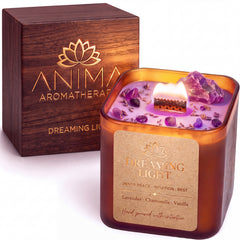
Everything for a few quiet minutes of your own: a crystal set, a candle, and white sage and palo santo incense, chosen to go together.
In your bundle
The energy quiz
Which energy is seeking you?
A few quick questions reveal the energy calling you now.
Zodiac crystal sets
Find your zodiac crystals
Six crystals that carry the energy of your sign.
Good to know
Lepidolite brings ease to times of change, soft as lilac and just as calm. Hold it, set your intention and breathe deeply, and you will feel your grip loosen and the change ahead grow lighter. Each breath lets a little more go. You are the creator.
Yes, for everyday handling. It is soft and sheds fine flakes, so keep it out of drinking water and out of reach of young children, and do not cut or grind it at home.
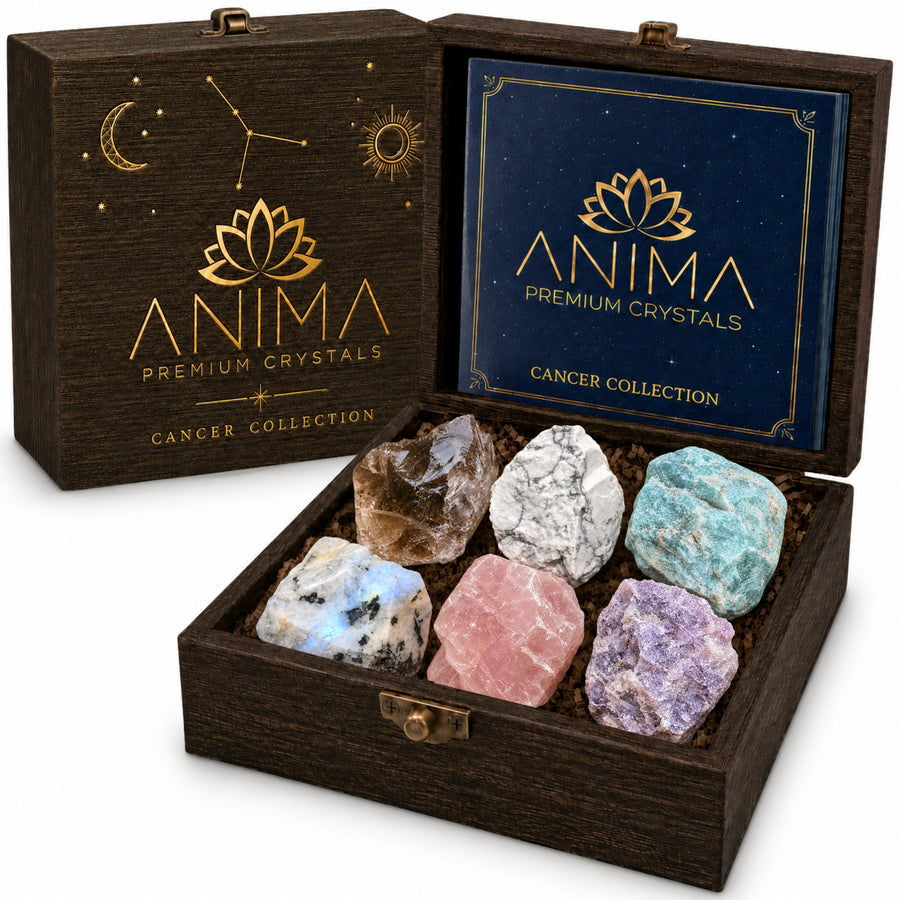
In our collection, lepidolite is one of the six crystals in the Cancer, Scorpio and Pisces sets, the three water signs. Its gentle energy of acceptance meets their deep feelings with calm, so change flows instead of overwhelms.
Its name comes from the Greek lepis, scale, for the small, shining flakes it breaks into. Martin Heinrich Klaproth named it in 1792.


